
Kmart Housing: Concept Images Vs. Reality
 By Peter Carzasty
Opinion PieceThe Townie is an opinion website. The views expressed in this piece belong solely to the author, and do not represent those held by The Townie.

Renderings are visual representations of future architectural designs for building projects. These images are used as a sales tool in architecture, allowing developers to secure consent and sell their projects to decision-makers, public officials, and the community at large. Using programs like Photoshop or AI, these images can be created with great detail and realism. However, this ability to manipulate the rendered image has often led to an unreality between what is rendered and what actually constitutes the finished building. At that point, it is too late to redo, as architecture is often called “frozen music.” The rendering practice has a significant implication to the most important urban development project in recent years here in Newburyport — The Kmart location known as Plaza Landing.
But first, let’s examine a recent example here in town, of what I term a false narrative — The Residences on the Ridge at 95 State Street. Take a look at the rendering hung from the construction fencing, and gaze upward to see the reality. Does the fanciful and almost bucolic representation match the building? First, the rendering is angled from a vantage point that isn’t possible in real life. Remember on TV Sitcom, Frazer, where his apartment building allows you to gaze over the skyline of downtown Seattle, where, actually, that vantage point doesn’t exist? A false reality.
Further examination reveals a building whose bulk is reduced, and that appears to set back further from the roadway, giving it a less hulking and threatening appearance. The secondary carriage house is portrayed in a different physical relationship to the main structure, which isn’t true. The next test of rendering to reality will be the cladding and landscaping when the construction fencing is removed. Will it match the image, or will it only vaguely resemble what was promised? But most of all, the rendering deceives regarding the scale relationship to the streetscape. And will we get that curing brick sidewalk wrapping around State and High Street and the classic New England stonewall?
This leads me to two other current examples in the infancy stage—the new proposed mixed-use development 49-57 Merrimac Street and Newburyport Landing luxury Townhouses. First, Scott Brown Architect’s rendering of 49-47 is an example of “reality rendering.” As envisioned, it presents an honest representation of what will most likely be built on the site, with sensitivity to a central, significant element – scale. It is rendered with individuals walking, which clearly indicates a sense of a building integrated into the environment, contextual in nature, and without appearing disproportionate to the surrounding structures.
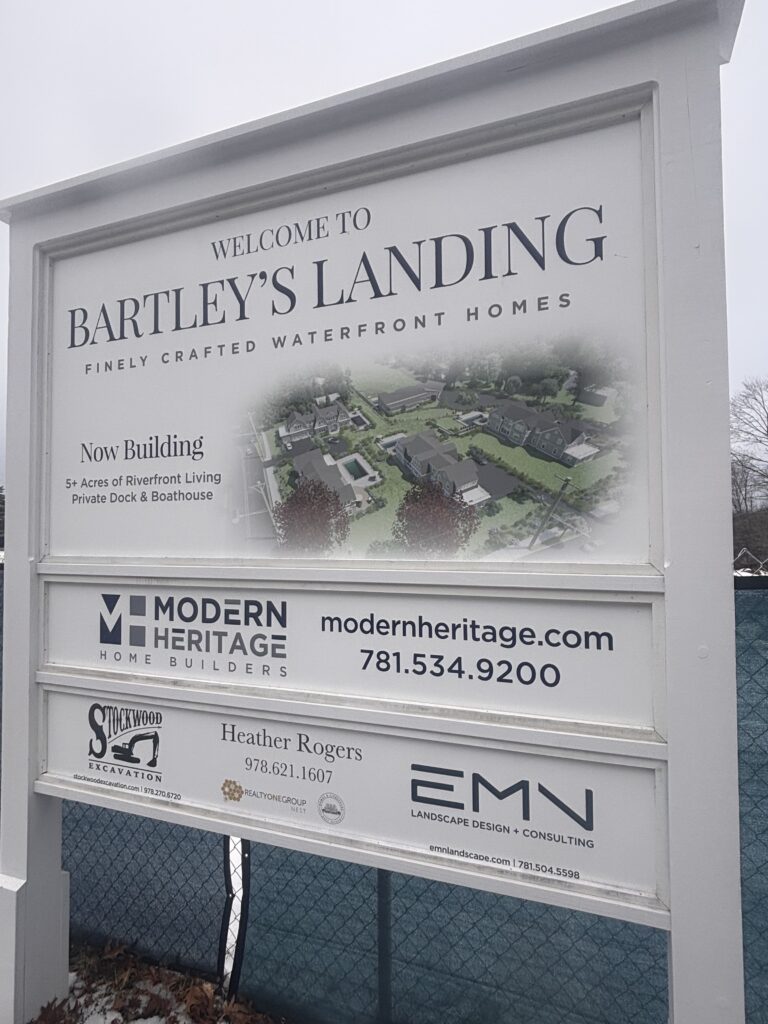
The verdict is out on Newburyport Landing Luxury Townhouses. The site has been cleared and is being readied for laying foundations. The rendering banner shows an aerial view, as if a drone were called in to capture a completed site, in vaguely referential terms. When fully realized, what will be the visual impact of the complex at this most critical traffic junction—a central welcoming portal to the city—traversed by a hundred each day serving also as a major commuter artery.
Finally, and perhaps with the most significant implications, is Plaza Landing. An internet search has turned up only a single, extreme, very vague, and almost abstract distorted black-and-white. The city’s document from the developer issued in September of 2024 has two renderings – one from Low Street, the other from Shaw’s parking lot, along with other visuals on the project.
While helpful, there are hidden elements – or lack thereof, that don’t totally tell the entire story. From these images, a lot will be dependent on the surrounding landscaping and a true representation of to help mitigate the size and bulk as well as the uninspired façade treatment.
Slight adjustments have been made in visual renderings, but the project is a 40B permit referring to a comprehensive permit under Massachusetts General Laws Chapter 40B, which allows developers to bypass certain local zoning laws to build affordable housing, provided that a portion of the units are designated as affordable. According to Andy Port, Planning Director, all potential waiver requests by the developer haven’t been received. Let’s hope none are related to the exterior façade and material treatment.
Suppose architecture is truly “frozen music.” In that case, it’s imperative to watch closely what the developer could potentially present as a waiver, as it could determine whether the finished structure strikes a visually discordant chord. That would be a potentially unappealing, possibly even jarring element in the visual landscape that the community will have to live with for a very long time.
Peter B. Carzasty is a transplanted New Yorker, and owner of Petey4Paws.
View Author Profile→6 Comments
Just to clarify one point: updated plans and presentation materials for Plaza Landing have been posted throughout 2025 on the City’s OpenGov site (https://newburyportma.portal.opengov.com/records/69450), including revised visuals included in each public hearing presentation. Those materials reflect the most current version of the project before the ZBA. More broadly, in a comprehensive permit process, what ultimately governs the outcome are enforceable conditions. Concept plans evolve during review, and any concerns about specific design elements must be addressed through conditions that are clear and binding.
Lisa, I conducted a thorough search for the most up-to-date renderings. I reviewed the link you provided before submission, but didn’t find any current renderings. If I missed a ‘click-through’ to updated images, please let me know. As a result, I directed The Townie to the ones I found–the image used in the piece (see link below) This document is dated September 18 2024 – I would be interested to review any rendering after that date that might update my thesis. https://www.cityofnewburyport.com/sites/g/files/vyhlif12211/f/mai/files/kmart-ppod-slides-2024-9-18-final.pdf If I missed any, please point me to the renderings you believe are current. To confirm my understanding, I contacted Andy Port for clarification on the current design status and the ongoing waiver process. I updated my original text based on my conversation with Andy and the various factors related to a 40B project. Thank You – Peter Carzasty
The current renderings are available at the link I referenced (https://newburyportma.portal.opengov.com/records/69450). Please go to the Files tab and look for the following uploads. 2025-11-12_ZBA_Hearing_TAT_final.pdf Uploaded November 12, 2025 at 12:36 PM. This file includes updated architectural renderings. 2025-12-09_ZBA_Hearing_rev.pdf Uploaded December 9, 2025 at 1:58 PM. This file includes the most recent architectural renderings. These files contain the up to date renderings.
Thank you, Lisa. I reviewed the current images. How depressingly predictable that NBPT’s most significant new building will be yet another soulless, cookie-cutter box, indistinguishable from the bland sprawl littering Rt. 128 and I-95. Kaplan’s architects have demonstrated a stunning lack of imagination and respect for our community—apparently, slapping some bricks on a façade is supposed to fool us into thinking this is “contextual.” It’s not. The design is so utterly devoid of life or distinction that it’s an insult to the city’s character. But what else should we expect when “value engineering” becomes the guiding principle before a single shovel touches the ground? This isn’t just disappointing—it’s a missed opportunity that will haunt the cityscape for decades.
The second rendering, from the Low Street side, looks like it was created by someone who has never driven, walked, or perhaps even laid eyes on Low Street. Unless there are major traffic mitigation strategies as part of the plan, people are not going to be casually walking around on the Low St side of this complex unless they want to get hit by a car. I am a supporter of the Kmart project (at least in concept) but that drawing is just very disconnected from reality.
Amy, That rendering doesn’t show the wall or landscaping currently next to the Low St. sidewalk. It seems to indicate a sidewalk between parking and building. I’m disappointed with the sidings, which match Boston Way. Wish they would match the Bresnahan.