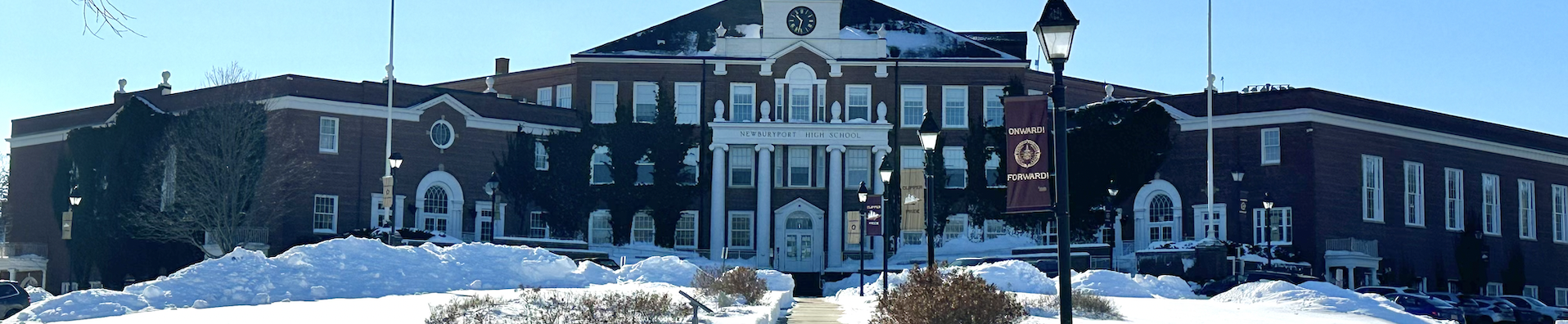
High School Causes Conformity and Burnout. We Need Alternatives

The Townie is an opinion website. The views expressed in this piece belong solely to the author, do not represent those held by The Townie, and should not be interpreted as objective or reported fact.

For many individuals, the American high school experience is a pleasant one. A time of growth and discovery within a climate of routines and order punctuated by tradition, ceremony, and celebration. Upon reflection, the high school years are often looked back on with nostalgia and affection by many. With its grand architecture, healthy funding, and talented faculty, Newburyport High School offers an above average experience.

The four years of high school are also a bridge that transitions a child from a student to a young adult who is prepared for either higher education or the workforce. By many accounts, the institution of high school does its job well, particularly if you are looking at it through a lens of assimilation. Specifically, how the student can assimilate to higher academia and eventually find their role in a company or organization. High school says, “we’ve done our job” and capitalism says, “thank you very much.”

For some, however, this system does not work. Above all else, high school focuses on metrics of grades, attendance, and scores. In order to succeed within this framework there is a certain amount of diligence and commitment that is required by the student. This diligence and commitment is required past the hours that school is in session and bleeds into evenings and weekends. Outside of school vacation and summer break, high school is essentially the student’s entire life, mirroring a similar framework of their eventual career.

So, what’s the problem here? This system seems to be working so far, no?

The problem is that for a student to succeed in the high school model it requires one thing of them: total abandonment of the self. 

Adolescence is a period of great transition for a young adult. Among physical changes they are also experiencing a myriad of psychological and emotional revelations. It is during these vulnerable years that one discovers their power, discernment, value, and voice. What we sometimes refer to as “acting out,” is often them simply trying out different behaviors to see where their own boundaries and those of others lay. This is also a critical time in terms of passing the torch of health and self-care habits that their parents once nurtured. A time when we should be teaching them to tend to their needs first and foremost, and instead we encourage the opposite.

Waking up at 6:00am to rush to a building where a student is expected to immediately engage in a topic of study only to be interrupted abruptly 45 minutes later and expecting them to repeat this cycle for the next 7 hours is absurd. It serves nothing but a system. Classist attendance policies that require permission from a physician to simply take time off when feeling ill teaches the student that their own judgment regarding their health and wellness cannot be trusted and will not be considered, furthering the agenda of the medical industrial complex. Students spend four exhausting years completing a series of general education courses that can easily be finished in two years or less. If the student is college bound, they then go on to repeat these same general education courses at university, but this next round comes with an astronomical price tag. 

Although there are many alternatives to the traditional high school experience there, is one that is quite simple and affordable: community college. We are fortunate to have both Northern Essex Community college and North Shore Community College in commutable distance. Students as young as 14 have the educational base to pass the placement test of many community colleges, whether they are traditional placement tests or the more commonly used guided self-placement tests. In either case, most community colleges will work with the student to prepare them for matriculation.  Once onboard, the student now has the freedom and autonomy to design their courseload around individual needs. Upon completion, the student will have an associates degree that they can build a career around or transfer into a four-year college. Factors like evening classes, summer intensives. and online courses support a balanced lifestyle that is conducive to who the student truly is: a sovereign being.

Adolescence should not be a time of conformity. It should be an awakening to the power and responsibility of every individual.  These years set the groundwork for the relationship one has with oneself during adulthood. One of the reasons the “self-care” movement and industry has been trending for so many years recently is because Gen X and Millennials have had to quite literally relearn how to properly care for themselves after decades of neglecting basic needs in favor of serving a system.

The timing feels auspicious in the current cultural climate for setting a new standard for our youth transitioning into adulthood. Let us encourage young adults to do what generations before them have struggled with. Let us create spaces for them to truly take care of themselves, and in doing so, each other.

Marianne Curcio
Newburyport resident

Passionate about a local issue? We want to hear from you. Check out our submission guidelines.

Subscribe to our Newsletter


Comments

3 responses to “High School Causes Conformity and Burnout. We Need Alternatives”

  1. Jim Higgins Avatar
    Jim Higgins

    Parroting your words, forgive me, but the “problem is that for a student to succeed in the community college model it requires one thing of them:” successful completion of the high school model!
    It’s called progression! A demonstration of abilities and comprehension that justify the last four years were actually productive in developing a young adult to succeed in the next chapter of growth.
    High school years are the time to wean teens from parental coddling. Training them to take responsibility for their actions and encouraging the blooming know – it – alls to celebrate accomplishments they’ve achieved through their OWN efforts.
    Advanced placement courses are available for any student who feels unchallenged but it doesn’t matter if they can’t arrive on time, which will be required in the next chapter and beyond. We all got over the early start time, even if on some days our sox didn’t match.
    If we truly want to encourage young adults to do what generations before them have struggled with, let’s give them the tips to help them from making stupid mistakes. Allowing adolescents to dictate their idea of high school participation doesn’t seem to be the solution to achieving honor roll status.
    Until teens reach the ripe age of eighteen remember that parents are the responsible party to protect and care for their needs. Too many are quick to blame the “system” for little Johnny’s inability to properly brush his own teeth and wipe his own butt.
    Personally, my adult years would probably have been much different if, as a high school student, I was permitted to author my own permission slips.
    Just sayin’.

  2. Charlie D Avatar

    There’s a significant body of scholarly work that argues public education in the West has historically functioned as a mechanism of social control rather than merely as a means of promoting knowledge or upward mobility.

    Agustina S. Paglayan of the University of California, San Diego (UCSD) explores the topic in Raised to Obey: The Rise and Spread of Mass Education, November 2024.

    From an author interview in UC San Diego Today:

    “Paglayan uses evidence from both the past and the present to argue that schools around the world are failing to cultivate critical thinking skills in students — and that these institutions are actually designed to promote conformity. The book has already been praised by 2024 Nobel Laureate James Robinson as “path-breaking and iconoclastic,” and Paglayan’s perspective promises to open new debates in politics and education.”

  3. Dr. Andrea Silva McManus Avatar
    Dr. Andrea Silva McManus

    Reflections on High School Experience and Reform
    Educational Background

    I graduated from Newburyport High School, Class of 1982, and later earned a Doctor of Education degree from the University of Vermont. My dissertation focused on high school reform, a central theme throughout my professional career. During my time in high school, I was enrolled in the college prep track and subsequently attended college in Vermont. While I felt mostly prepared for college, I struggled with a significant math phobia that originated in the Newburyport Public Schools and was never addressed during my earlier education. Therefore, I had to take remedial math, my Freshman year, so I’d call that a system fail. This issue was finally resolved in my Master’s Program when I was 24 years old. If my math phobia had been recognized and managed earlier, I likely would have pursued a more lucrative career path. However, this is not the main point of my reflection.
    Leadership in High School Reform
    I led Vermont’s high school reform initiatives, resulting in a notable 22% reduction in the dropout rate from 25% in 1999 to less than 3% now. A model for all high schools was adopted in Vermont and became law, and the outcomes have been incredible. Including creating multiple pathways to graduation, which recognize and support all learning styles. These efforts also established a robust dual enrollment system that has saved families tens of thousands of dollars. My experiences have informed my perspective on education, and I am willing to share my insights with others interested in reforming high school education in Newburyport if anyone would like to invite me to come share them.
    Perspectives on Education
    While I agree with some points made by the author of the article and I thank her for writing it, I do not concur with all of them. It is important to recognize that the human brain continues to develop well into the twenties, necessitating a balance between structure, guardrails, greater independence, and more opportunities for individualized studies in high school education. Workbased Learning is and should be a part of the high school experience.
    Challenges in High School Education
    Traditional teaching methods, such as the banking model, where teachers deliver knowledge and students simply regurgitate it through standardized testing, are too limited. This approach primarily benefits students who excel in this type of learning, but it does not serve those who prefer hands-on experiences. All learning styles should be valued, and students must be given opportunities to express themselves in ways that best suit their needs. In Vermont, we have implemented changes to support diverse learning styles. High School needs to prepare students for all pathways, including the military, higher education, and work. It should also provide financial education, which I see Massachusetts is adding to its graduation requirements.
    Motivation for Reform
    Although my high school experience was both challenging and rewarding, the shortcomings I encountered motivated me to pursue a career in education and non-profit organizations. Specifically, my focus has been on high school reform, driven by how my own education could have been improved and the personal costs of those gaps.

Leave a Reply to Charlie D Cancel reply

Your email address will not be published. Required fields are marked *