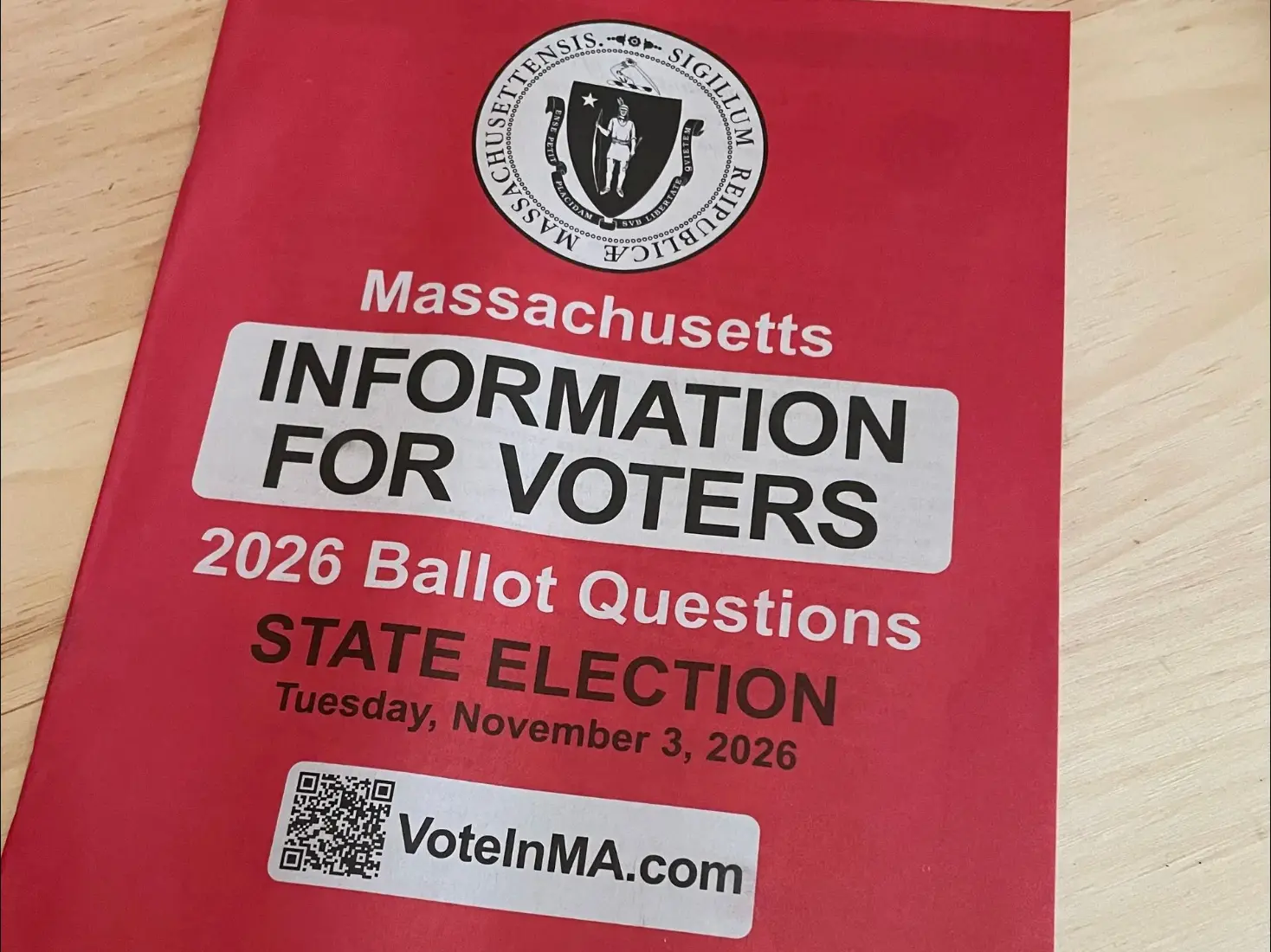
Have you completed your election homework? I get it. Life moves fast. So, take a beat. Study. It’s not a pop-quiz on November 3: all nine ballot questions are published on the Secretary of State’s website and printed in the red book delivered to every registered voter.
The goal here is to inform. In the words of my Constitutional Law professor, the best way to inform is to not be able to detect someone’s politics. I hope to not fail epically here as I aim to offer clear, factual summaries, and opposing arguments. Eight ballot questions, if approved by voters, will become law; the ninth question affirms or repeals a current law. Whether you are in it for your voice, wallet, or the stickers (you know who you are) – YOUR VOTE MATTERS.
Question 1 – Expanding the Public Records Law.
Yes: Apply the Public Records Law to the Massachusetts Legislature and Governor’s Office.
No: Keep current exemptions.
If this sounds familiar, it is. In 2024, voters approved State Auditor Diana DiZoglio initiative to audit the Legislature by 72%. It is law. However, Massachusetts voters are still waiting for their audit as the Massachusetts Legislature is split on party lines: Democrats advanced a bill limiting release of records unless approved by the House Speaker and restricting the ability to challenge denials in court; Republicans voted against it, citing voter intent to proceed with the audit.
Opponents argue the 2024 ballot question was too broad and that subjecting the Legislature to public records law violates separation of powers by giving the Executive branch oversight of the Legislative branch. Auditor DiZoglio, a former state Representative and Senator, Democrat party, initiated this new ballot question to reinforce the 2024 vote, while she continues to seek enforcement before the Supreme Judicial Court. This new ballot question also narrows record disclosure, exempting: 1. records related to public policy development; and 2. communications between legislators and constituents seeking help with government services. Auditor DiZoglio argues that Massachusetts is the only state where the Legislature, Governor’s Office, and courts are fully exempt from public records law – making this a transparency and accountability issue.
Question 2 – Collective Bargaining for Committee on Public Counsel Services (CPCS) Employees.
Yes: Allow CPCS employees to unionize and collectively bargain.
No: Keep current structure.
CPCS provides constitutionally required representation in civil and criminal matters for residents who cannot afford an attorney. In May 2025, CPCS staged a work stoppage over low hourly rates and cost-of-living concerns. The result: 1,689 cases were dismissed and 213 defendants released on bail due to lack of representation. FY26 budget language increased pay rates; however, private defense lawyers sued in 2026, arguing the raises still did not cover overhead costs such as office space, malpractice insurance, and technology.
Proponents argue CPCS employees should have the same rights as other state workers to negotiate wages, benefits, and working conditions. Opponents counter that CPCS operates as an independent judicial branch agency and unionization could disrupt operations. Any collective bargaining agreement would require appropriations from the Governor, making fiscal impact uncertain.
Question 3 – Single Party Primary.
Yes: Replace party primaries with one ballot listing all candidates; top two advance.
No: Keep separate party primaries.
Also, this question would combine governor/lieutenant governor into a single ticket.
Proponents argue a unified primary ballot increases accountability, transparency and debate – especially when party candidates run unopposed. Opponents argue the system favors wealthy candidates, reduces competition, and may decrease voter participation.
Question 4 – Election Day Registration.
Yes: Allow voters to register or update their address on Election Day.
No: Keep the 10day registration deadline.
Currently, voters must register 10 days before Election Day. Provisional ballots are available, but 60% of provisional ballots were rejected due to errors, according to proponents.
Supporters argue Election Day registration maximizes voter access and the state has a year to train poll workers. Opponents warn of increased fraud risk, lack of funding, and compare the cost to the $8 million spent implementing early voting.
Question 5 – State Revenue Limit.
Yes: Cap annual state revenue based on a calculation of the prior year’s net revenue plus wage growth averaged over the prior three years.
No: Keep current revenue rules.
Proponents argue excess revenue – estimated at $1,500 per household – would be returned to families. They frame the measure as fiscal accountability without reducing spending on education, health care, or transportation.
Opponents argue revenue caps would force cuts to schools, health care, housing, and public safety, and could increase property taxes.
Question 6 – Natural Resource Conservation Fund.
Yes: Create a “Nature for All” fund receiving 50% of taxes from sporting goods, recreation vehicles, and golf courses until 2028; potentially 100% thereafter with legislative approval.
No: No change.
Proponents argue the fund increases conservation resources without raising taxes. Opponents argue the measure diverts up to 100% of an existing tax base from programs already funded by those revenues. Even if voters approve, appropriation transfers still require legislative approval.
Question 7 – SingleFamily Homes on 5,000 sq. ft Lots.
Yes: Allow single family homes on lots of 5,000 sq. ft or more, subject to statewide regulations. No: Keep local zoning authority unchanged.
Proponents argue this would expand affordable housing options for young families and seniors. Opponents argue the measure imposes a one-size-fits-all mandate that overrides local planning boards and individual community needs.
Question 8 – Repeal Retail Recreational Marijuana.
Yes: Repeal the 2016 recreational marijuana law; shift dispensaries toward medical operations. No: Keep the current regulated recreational market.
Recreational marijuana was a ballot question in 2016 that was approved by 54% of voters.
Proponents of repeal cite statistics since commercialization: marijuana is the most common drug found in fatal car accidents; ER visits from teens with psychotic conditions have increased; and, taxpayers spend $4.50 for every $1 in tax revenue to mitigate legalization impacts. Opponents argue repeal would create an unregulated market, remove safeguards, eliminate hundreds of small businesses, thousands of jobs and billions of state tax revenue.
Question 9 – Firearms Regulation.
Yes: Affirm the 2024 firearms regulation law.
No: Repeal it.
Proponents argue the law’s key elements are already being implemented and that Massachusetts’ gun death rate is 70% lower than the national average. Opponents argue the law passed without proper planning including an unfunded electronic tracking system and imposing vague rules that limit civil rights. Instead, opponents call for transparent, common-sense legislation.
These summaries are extremely brief and should not replace your own research. Much of the information above comes directly from Information for Voters 2026 Ballot Questions Guide; Review the fiscal implications, opposing arguments in-depth, and minority/majority reports for each question – and the non-binding Question 10 for First Essex – on the Secretary of State’s website. Always confirm election information with trusted official sources.