
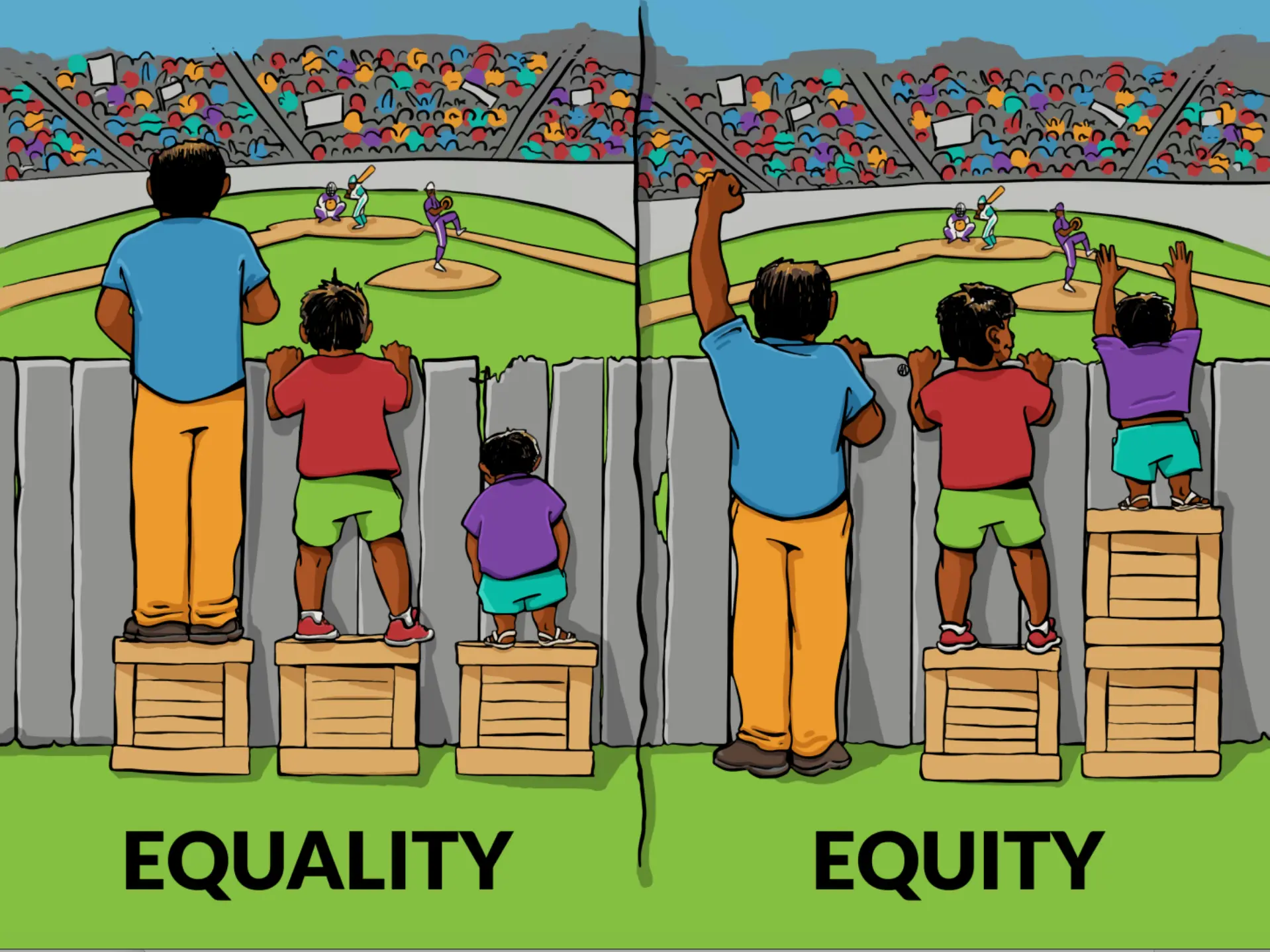
Think about a playground that becomes unsafe because no one fixes the broken equipment. One repair is postponed, then another. Eventually, the city closes it because the danger is greater, the cost is higher, and the options are worse. Were the children the problem? Of course not. The adults waited too long.
The same is happening with our school budget.
Every Newburyport School Committee budget season sounds like Groundhog Day: funds do not match actual costs; programs and services face cuts; special education costs rise; state formulas fall short. The same warnings. The same explanations. The same last-minute pressure.
Newburyport must decide what equity means and what our budget should prioritize.
Equality offers students the same thing.
Equity provides what each student needs to access an education.
A laboratory or production studio may be equally available to students in the building. But if a student cannot attend because the district has not created an appropriate program, that equal opportunity means nothing.
Listen, I am not arguing against families’ hard-fought out-of-district placements. Some students need highly specialized settings, and placement decisions must be based on their individual educational and clinical needs. But simply sending students out of district instead of developing a continuum of services is not the answer. The law requires inclusion whenever appropriate.
Additionally, federal law requires school districts to offer a continuum of placements — a range of educational settings that can be matched to each student’s individual needs. That range begins with a general education classroom with supports and extends, when necessary, to specialized classrooms, separate day programs, home instruction and residential programs. The district must also educate each student in the least restrictive appropriate setting.
Convenience is not the standard. Whatever programs already exist in-district are not the standard. The student’s individual needs set the standard.
When a district fails to build or maintain specialized in-district programs, it creates an artificial crisis. Then it acts as if sending students out of district is the only choice. But the district does have a choice: make a plan, hire specialized staff, build local capacity, and meet its legal responsibility to educate all students in-district at a fraction of the cost. Failing to build that capacity is a local system failure.
And this is about more than cost. Students have a right to belong in their communities – to attend school near siblings, neighbors, and peers. Every student has a right to an education. Learning differently does not diminish that right. Inclusion creates relationships and opportunities that no spreadsheet can measure. When schools invest early in the right services, students – including students with disabilities – are more likely to become independent adults who can work, participate in their communities, and need fewer costly supports later in life.
A better comparison: if a family has a two-bedroom home and another child is born, the family does not say, “There is no room, so this child must live somewhere else.” The family figures out how to make room. A public school system should begin with the same commitment: These are our students. How will we serve them?
Newburyport’s FY26 and FY27 budgets make the warning impossible to ignore. Out-of-district tuition rose from $2.25 million to $4.98 million as placements increased from 27 to 34 students. Total special education spending rose from $12.5 million to $15.8 million. Meanwhile, the district cut 13.5 full-time-equivalent positions in FY26 and another 7.3 in FY27. Some placements can cost hundreds of thousands of dollars a year; one cited tuition reaches $600,000—more than six times the roughly $95,000 to $104,000 annual cost of attending Harvard, Boston University or Dartmouth. Investing a portion of our spending in specialized educators, behavior analysts, therapists and therapeutic classrooms could serve multiple students locally for the cost of sending one or two elsewhere.
Here is the problem in plain terms: school costs are rising faster than the money available to pay them. According to the FY27 budget forum, 58 cents of every Newburyport dollar goes to our schools. Residents have every right to ask whether those dollars are being planned and spent responsibly.
Newburyport increased its school appropriation 4.33% to $41.1 million. Local tax dollars provide 86.6% of the school budget. Only six weeks into the year, supplemental requests came for doubled legal fees and the difference between the School Committee’s request and the amount approved by the City.
So what happens when the public budget falls short? Fundraising. As a former Newburyport Elementary PTO president, I know the volunteer hours and repeated requests to families and businesses. The Newburyport Education Foundation raises money on a larger scale.
NEF’s website says its mission is to offset financial pressures on the school system, including technology needs and rising special education costs, and describes an “inequity” between government funding and school costs. But an inequity is an injustice. The deeper inequity occurs when a resident student cannot attend school in the community because the district failed to build the services that student needs.
This is where resource choices become moral choices. A new laboratory, podcast studio, or production studio attracts attention. Specialized staff and therapeutic programs may not. But all the shiny new things mean little if Newburyport cannot educate every resident student.
Sound budgeting cannot wait. Newburyport needs a public, multiyear plan that identifies missing services and compares the cost of local programs with projected tuition and transportation.
Some students need out-of-district placements. But every decision must begin with individual need — not the absence of a lawful local option.
Do not wait for more staff cuts while another amenity moves forward. A school system should be measured by whether it can teach every student—not by its newest equipment.
The priority (and the law) are clear: meet students’ needs, build local capacity, and fund enhancements only after that foundation is secure.
Otherwise, Newburyport will keep cutting staff, reacting to rising costs and asking families and taxpayers to close predictable gaps. Replace crisis budgeting with disciplined, long-term planning.
Here is how to help:
1. Send one clear email. Ask for a multiyear plan that identifies missing services, needed positions and programs, projected costs and public timelines. Ask leaders to include it in the next budget – not a supplemental request afterward. Contact the Mayor and School Committee Chair, Sean Reardon, mayor@cityofnewburyport.com, Superintendent Sean Gallagher at sgallagher@newburyport.k12.ma.us, the School Committee at sc@newburyport.k12.ma.us, and City Council, citycouncil@newburyportma.gov.
2. Attend one School Committee meeting – virtually or in person. Ask: What programs will be built? When? What will they cost? View the Newburyport Public Schools meeting calendar.
3. Keep asking. Request timelines, cost comparisons, updates, and public records. Attention creates accountability.