

Thanks to Market Basket’s surprisingly excellent sushi, I was less skeptical about picking up a tuna roll at the 7-Eleven in Tokyo. Often, my Market Basket sushi doesn’t even make it past the parking lot, and I just throw the packaging in the trash can by the exit. Sometimes I eat by the waterfront, and simply toss my wrapper in one of the four trash cans within a 100-foot radius. I assumed disposing of my convenience store sushi in Tokyo would be similarly convenient. But I had only been in the city one day, and hadn’t yet learned the most important rule of snacking in Japan: public trash cans are as rare as forks.
I walked several blocks looking for that familiar black beacon of waste disposal. Nothing. My brain kicked into fight-or-flight mode. Was I really going to carry this wrapper all the way back to my hotel? Should I just toss it on the sidewalk when no one’s looking? No, I wouldn’t get away with it. Unlike Boston, or even Newburyport, my litter wouldn’t just blend in with everyone else’s; these streets were immaculate, and leaving even one wrapper on the concrete would feel like polluting a sacred spring.
Then I noticed another absence: smells. Tokyo didn’t smell like a typical city, whose air carries a hint of trash and sewage. It didn’t smell like anything at all, except some fragrant azaleas. That’s when my frustration shifted – away from the Tokyo Public Services department, and toward our own approach to waste back home.
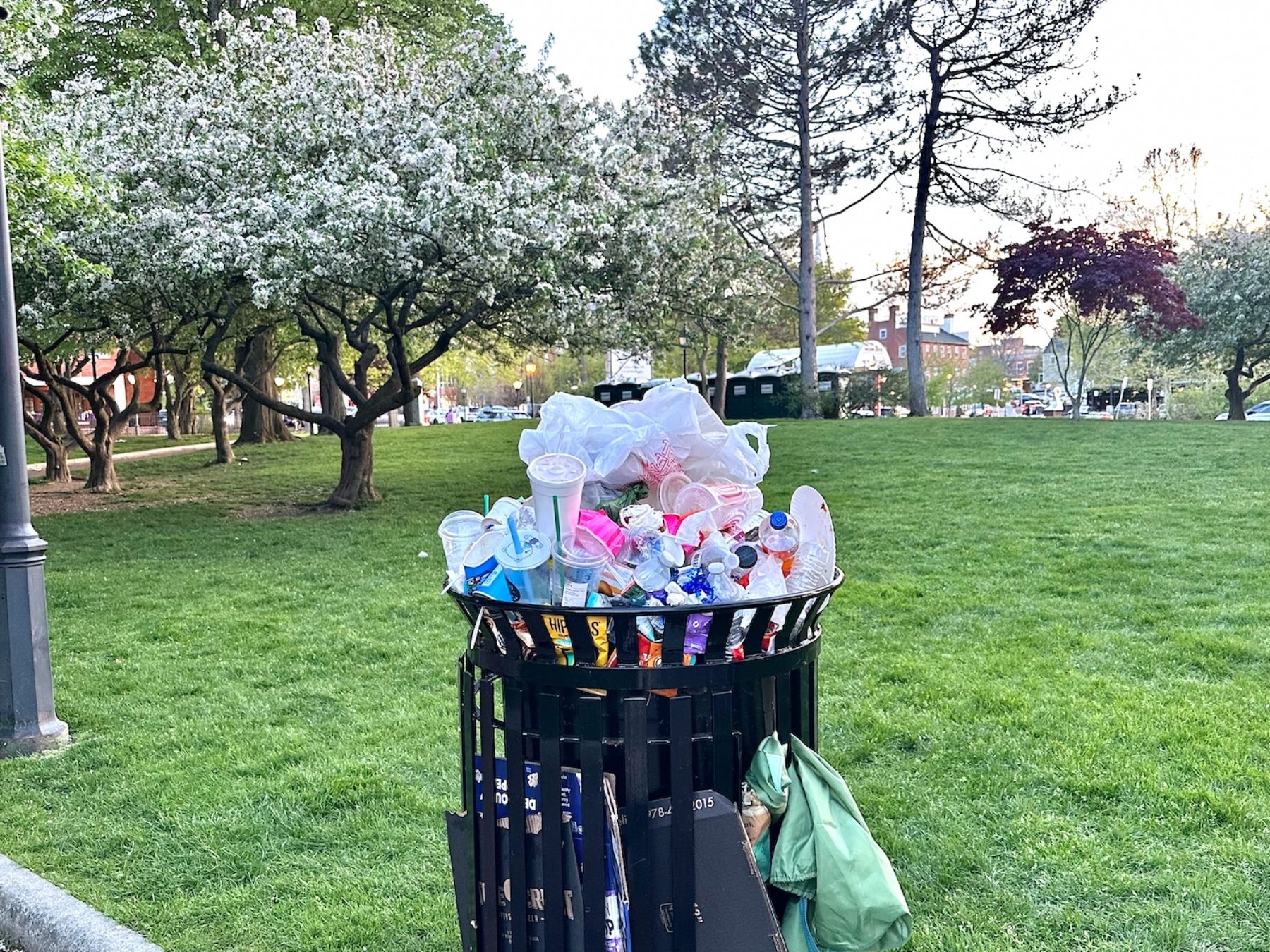
In Newburyport, we’re lucky to live in a relatively clean, environmentally conscious city. We don’t have the same waste management issues that larger – or less affluent – cities do, but after spending two weeks in Japan, I couldn’t ignore the Abe’s Bagels bag blowing down Liberty Street, or the empty Juicery cup bouncing along the boardwalk like a tumbleweed. Walking to the Goat in the early evening, I noticed the two trash cans flanking the Firehouse lawn filled to the brim, sun glistening off some Diet Coke cans.
I wondered if Japan’s approach to trash was possible here. To answer that question, I did some research and learned that Japan used to have trash cans like the rest of us, until a 1995 sarin gas attack on the Tokyo subway. Domestic terrorists hid the deadly gas in public trash receptacles, resulting in 14 deaths and thousands injured. As a precautionary measure, the vast majority of public trash cans were removed.
Instead of a public outcry, it seems the Japanese shrugged their collective shoulders. For the past 30 years, they’ve acclimated to this new reality by simply carrying their trash home with them. This shift in burden from government to individual is only possible because of the uniquely Japanese sense of personal responsibility. During my brief time in the country, I noticed that public space is treated with the respect of private space, and private space is treated with the respect of, well – a shrine. It’s why shoes are removed before entering homes, why people rarely eat on the street (it’s considered rude), and why many wear masks when sick (not to keep themselves safe, but to protect others). This sense of shared responsibility results in treating streets and sidewalks like a communal living room.
So, if the City of Newburyport removed all our trash cans in an effort to keep our streets clean, would it work? Would people actually bring their sushi packaging home in backpacks and purses, or would they “accidentally” let it slip from their hands on the boardwalk and hope it decomposes?
Success would require overcoming our American penchant for individualism. It would mean taking personal responsibility for public space, and prioritizing community over convenience. That’s a tall order in a country where individualism almost always triumphs over collectivism.
Look, I’m no Greta Thunberg. My inconvenient truth is that I don’t recycle as often as I should, and those multi-colored trash bins for different waste categories look like a Rubik’s Cube to me. I’m in no position to lecture anyone about sustainability or community responsibility. But ever since I saw those overflowing bins on the waterfront, I’ve been wondering if there’s a better way. A way that puts communal space ahead of personal convenience, without requiring a complete rewiring of our cultural habits.
I’m still not sure. What do you think?