
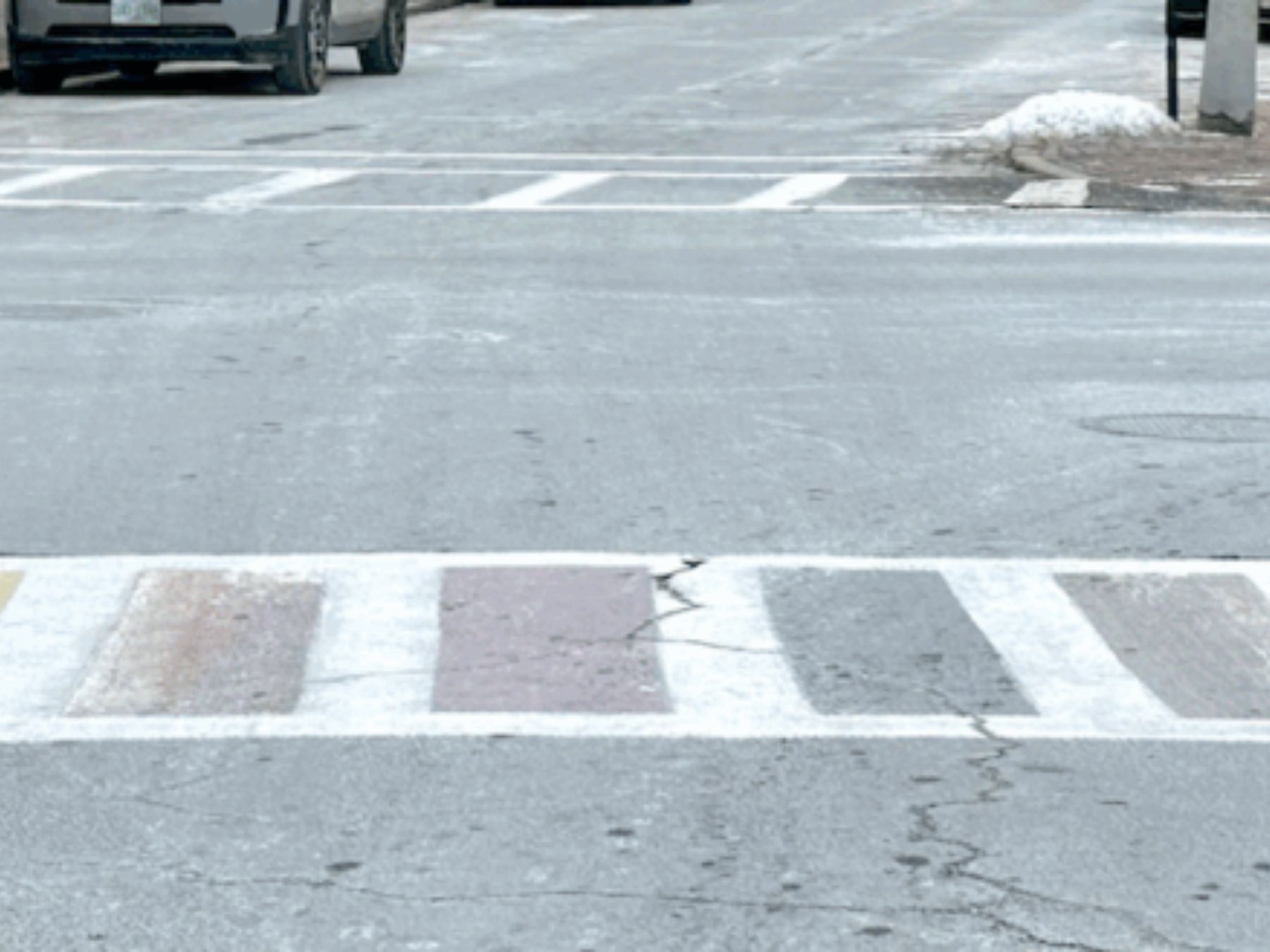
Well after dark, I drive down High St., squinting at the line of oncoming headlights, and, quite suddenly, there she is. A pedestrian casually strolling across, perhaps 20 feet in front of me, looking straight ahead, as if I’m not there, as if all those headlights coming the other way are there only to light up her way.
I pump my brakes rather than slamming them, taking the driver behind me by surprise. But she is already stepping across the center line, so I would likely miss her anyway.
No idea what, if anything, the next driver coming the other way does to avoid her, as I keep my eyes on my side of the road. But I do know this: Had my car or any car hit her, Newburyport would be in yet another uproar over “careless drivers” and the need for “lower speed limits.”
No matter that she crosses where there is no crosswalk. In Newburyport, pedestrians–and bicyclists–are always blameless, and the motorist is always guilty, evil, and immediately condemnable to hell.
Last month, in Ipswich, a woman was hospitalized when her horse was spooked by a bicycle on a nature trail. The horse had to be put down, and police, last I heard, were seeking the cyclist. If that happened in Newburyport, some people would demand that they find the owner of the nearest parked car to blame and hold liable.
Over the top? Maybe. But the basic story is something I’ve heard described by friends in other cities and states. Across the country, the reality we face in 2025 may be far closer to my exaggeration than it is to what all of us over the age of, say, 40 once took for granted.
Once upon an attention span, pedestrians followed two “Rules of the Road”:
Make eye contact with the driver before crossing in front of a moving vehicle
Wear light, bright clothing after dark.
Both are matters of common sense to a Truman baby–and I’ll venture to say to Eisenhower, Kennedy, Johnson, Nixon, Ford, and Carter babies such as my daughter. The points are so obvious that they should not need making.
The woman who appeared not far before my driver’s side headlight wore black slacks and a dark gray coat and hat. She may have looked my way before I saw her and decided she would reach the center of the road before I reached her. All I can say for sure is that she never made eye contact. Crossing the center line, which was as far as I saw, she never broke her unhurried stride.
We hear about reckless drivers all the time. Cars that go too fast, run red lights, tailgate, cut us off, never yield, blast their horns unnecessarily. As one who drove delivery vans for 25 years, I saw more of that than most.
This was as true in the Eisenhower years as it is now. I still laugh at the memory of my uncle in Akron telling my father, “Ohio drivers may kill you accidentally, but we’ll never be rude to you.” That, of course, countered the notorious reputation that we hear to this day of Boston drivers who “consider directional signals a sign of weakness.”
Today’s epidemic of reckless pedestrians was unheard of. Was it the “You can have it all” 1980s that started to erode the idea that we must pay attention to the world around us? Was it the advent of the cellphone that conditioned so many to think that they live in bubbles? Or just act as though they do without having to think at all?
I don’t know where the problem originated, or exactly how to solve it, but I know this: pedestrian awareness, not lower speed limits, is the place to start.