
The Townie is an opinion website. The views expressed in this piece belong solely to the author, do not represent those held by The Townie, and should not be interpreted as objective or reported fact.
Some readers have asked why The Townie does not more thoroughly fact-check the opinion pieces it publishes. The question deserves a serious response.
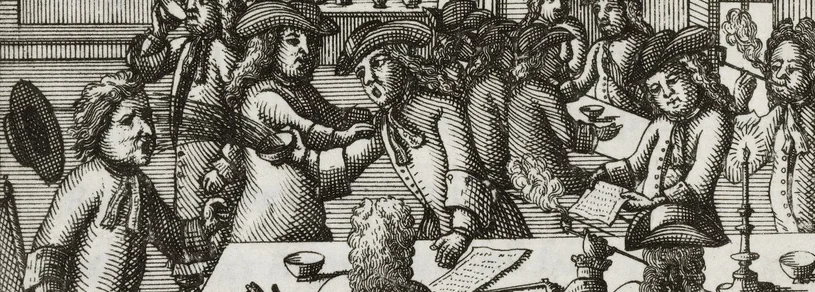
When I began writing to The Townie last year, I didn’t realize I was joining a 300-year-old form. In 1711, Joseph Addison launched The Spectator in London with a purpose that struck his contemporaries as eccentric, even quietly radical: to bring ideas “out of closets and libraries, schools and colleges, to dwell in clubs and assemblies, at tea-tables and in coffee-houses.” He was conceptualizing a new kind of media institution, neither a newspaper nor a publication of the crown – rather, a public square in print. Readers wrote in, argued in coffeehouses, debated in drawing rooms, and through this circulation of articulation, contestation, and revision, a community thought together.
A century and a half later, the same dynamic helped end American slavery. The apocryphal Lincoln line about Harriet Beecher Stowe – “So you’re the little lady who started this great war” – captures the popular memory of Uncle Tom’s Cabin’s influence. Newburyport’s own William Lloyd Garrison and The Liberator were also instrumental, but historians have shown that thousands of newspaper opinion pieces responding to Stowe’s novel – written by ordinary citizens and read by their neighbors – also helped shift public sentiment against slavery.
So opinion pieces matter. The question is whether editors should pull out their red pens, as mainstream newspapers like the Daily News do, or painstakingly fact-check opinion-based letters. The Townie takes a more hands-off approach.
Is this a good thing?
What The Spectator and The Liberator did is what the German philosopher Jürgen Habermas later called “the public sphere” – the conversational space, distinct from both the state and private life, in which citizens hash out matters of common concern and form public opinion that can influence government. Habermas’s insight was that the legitimacy of public opinion depends not on who certifies it from above but on how it is formed: through reasoned exchange among equals, where only the better argument wins. A “public” is a community that reasons together.
The public square is designed to challenge confirmation bias. Left to our own reading and networks, we drift toward sources that confirm what we already suspect. Private reasoning feels rigorous from the inside, but engagement in the public sphere breaks the circle. Common ground is not what we already share; it is what we discover we share, and where we differ.
A newspaper fact-checks because its readers receive its content as authoritative reporting. The Townie is not that. Its tagline calls it “a public square for the passionate voices of Greater Newburyport,” and the disclaimer on every letter tells readers plainly that what follows is opinion and “should not be interpreted as objective or reported fact.” The criticism asks it to become something it isn’t.
What the critics miss is that a public square’s work of testing claims does not happen through gatekeeping; it happens in the conversations that follow. A pre-screened letters page operates by a method of authority: the editor decides which claims merit consideration and hands the reader a pre-filtered set. A genuine public square operates in a manner by which claims are entered, contested, and revised — collectively.
My November piece on the absentee ownership of the Daily News drew many responses on The Townie’s website, and harsher ones on Facebook, yet substantive corrections surfaced. A former editor of the paper, who ran its newsroom for 14 years, offered insider context that expanded the picture I had drawn. Some readers agreed, while others felt I had not made the case for why ownership matters. I learned from those exchanges.
Last October, a letter argued that the Custom House Maritime Museum should not fly the Betsy Ross flag because the building is city-owned and the display therefore illegal. Within hours, readers pointed out that the city sold the Custom House to the Newburyport Maritime Society, that the legal claim was wrong, and that a 2022 Supreme Court case complicates the analysis even where public ownership exists. This is how common truths get shaped.
The most instructive example is recent. In April, Walt Thompson published a letter arguing that school choice costs the district roughly $2.8 million annually. The first commenter, Owen Smith, pointed out the hole: marginal cost depends on whether seats are surplus to capacity, and a district staffed for in-district enrollment can take school-choice students at near-zero added cost up to that threshold. He then asked the right question: how the city articulates how it determines surplus capacity by cohort. The second commenter wrote, in apparent frustration: “would it not make sense to at least screen submittals for factual accuracy?” But that screening had already been done by the comment above his.
This doesn’t mean anything goes. The Townie does decline defamatory content that promotes hate speech or harm, and should continue doing so. But editorial fact-checking of every claim would substitute one person’s judgment for the public’s reasoning, silencing the very process by which a community comes to better understanding.
Editorial stewardship at The Townie is meticulous, even if fact-checking is not emphasized. The editor, Eben Diskin, works closely with writers on clarity, structure, and length; I know this from extended (sometimes frustrating) back-and-forth exchanges on my own pieces. What is rightly absent is the pre-screening of topics and the pre-certification of every factual claim. That work belongs to the public.
This “distributed correction” works best at The Townie’s scale. When a letter circulates through a few thousand engaged readers – who run into each other at Market Basket or a school committee meeting – the stakes of being publicly wrong are real. What fails on a site such as Facebook can succeed here, because people know each other and the community is small enough to remain a community.
The Townie is one of the increasingly rare institutions where local people work out together what they think about local life, without the gatekeeping of a corporate press. Treating it as a flawed newspaper that needs more gatekeeping misunderstands what it is, and what it is for.
Sustaining The Townie as a public square puts a real responsibility on its contributors and readers. A civic space like this only works if citizens show up open-minded and do the work of articulation, response, contestation, and reconsideration. So must the (largely governmental) institutions our letters address.
What do we hold in common, and how will we govern those assets? The question I asked in March about water and land applies here. The Townie expects us to forge the answer together, in public, with our neighbors.
John Giordano
Newburyport resident
Passionate about a local issue? We want to hear from you. Check out our submission guidelines.
Subscribe to our Newsletter




Leave a Reply