
The Townie is an opinion website. The views expressed in this piece belong solely to the author, do not represent those held by The Townie, and should not be interpreted as objective or reported fact.
When I moved to Newburyport 25 years ago, I was stunned to see so much open space along Route 95 North just south of the Newburyport exit, puzzled at how this much land could not have been developed. 25 years later, it looks exactly the same.
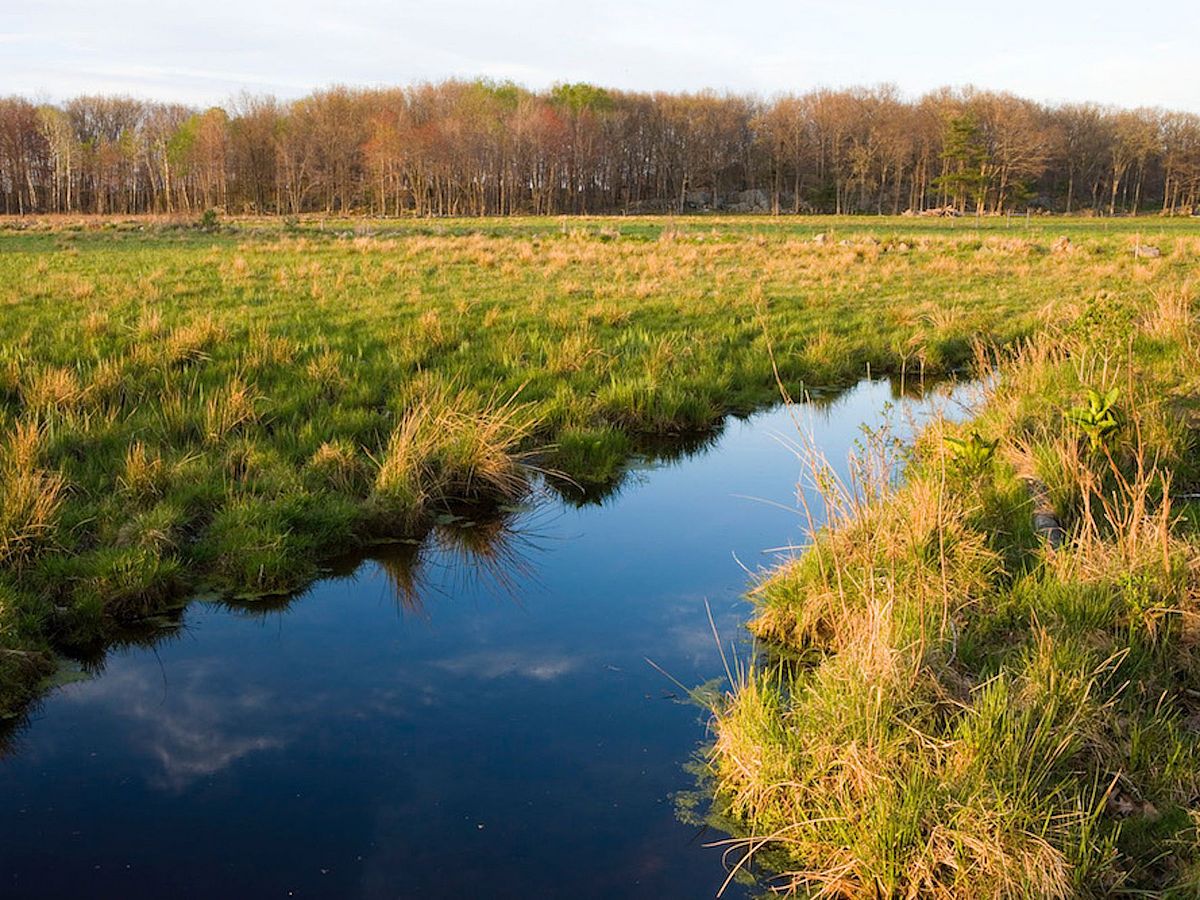
In 1635, the settlers of the Newbury Colony did something their descendants would spend the next four centuries slowly forgetting: they held land in common. The tract they called “The Common Pasture” was a remarkable shared open space. It was also a governance decision resulting from a deliberate, legally structured answer to the question of how a community survives when its members depend on resources that no single person can own or protect alone. Livestock needed grass. Families needed milk and wool. The pasture made that possible not by assigning private ownership but by defining shared stewardship. For nearly two hundred years, it worked.
The custom the settlers brought to the Newbury Colony wasn’t a utopian experiment. English villages had governed common grazing land since the medieval period through manorial courts that set limits on how many animals each household could put to pasture, enforced through graduated sanctions and community accountability. The commons wasn’t purely public nor purely private, but instead a third thing defined by shared use rights and collective governance. When the Newbury colonists arrived, “enclosure” — the conversion of shared land into private property — was actively dismantling these arrangements back in England, dispossessing thousands of rural families, and thus catalyzing, in part, emigration from England. The settlers transferred here what was actively being destroyed there.
That history matters because the problem the Common Pasture solved has not gone away. In 1968, the ecologist Garrett Hardin gave it a name: the Tragedy of the Commons. His argument was straightforward. When a resource is shared and unregulated, every individual has a rational incentive to take as much as possible before others do. When a herdsman adds one more animal to the shared pasture, they gain the full value of that animal himself, while the cost of the additional grazing is distributed across everyone who uses the land. So the rational choice for every individual is always to add another animal, even as the cumulative effect destroys the pasture that all of them depend on. The tragedy is not greed but structure: a system that makes overuse individually rational and collectively catastrophic. Multiply that logic across enough users and you get collapse — not from malice but from the structural mismatch between individual incentives and collective need. Hardin concluded that shared resources require either privatization or state control. His was an influential but incomplete diagnosis.
Political scientist Elinor Ostrom won the Nobel Prize in economics in 2009 by demonstrating what Hardin missed: that communities can govern shared resources sustainably, without either resorting heavily on private ownership or top-down regulation, when they design the right institutions. Her eight design principles emerged from studying over 800 real communities worldwide: 1) clear boundaries, 2) rules proportional to local conditions, 3) collective decision-making by those who live under them, 4) monitoring, 5) graduated sanctions, 6) accessible conflict resolution, 7) local autonomy, and 8) coordination across multiple governance scales. The commons fails not because sharing is unworkable but because governance structures fail to match the complexity of the resource they are managing.
The contrast between commons-governance failure and success plays out vividly along the North Atlantic and New England coast. The Canadian Grand Banks cod fishery collapsed in 1992 after decades of industrial overfishing, erasing 42,000 livelihoods overnight and an ecosystem that has not recovered in 30 years — a textbook Tragedy of the Commons, driven by exactly the governance vacuum Hardin described. Meanwhile, the Maine lobstermen quietly built something closer to what Ostrom envisioned. Through informal territorial systems, local fishing councils, community monitoring, and norms developed and enforced by the fishermen themselves, they created a self-governing commons. The lobster stock has remained robust precisely because the people most dependent on it retained meaningful authority over the rules governing it. The community accomplished this, rather than a federal agency.
Newburyport is not the Grand Banks. But the structural logic is operating right now on three resources this community shares and that none of us can protect alone.
The Common Pasture acts as a natural massive sponge when it serves as the city’s groundwater recharge source. The state’s own Source Water Assessment recommends acquiring land within the recharge zones because protecting the aquifer now costs far less than treating contaminated water later. The aquifer doesn’t respect property lines or municipal boundaries. It is a commons — and the governance questions Ostrom would ask are urgent ones: who monitors the system, who sets the rules governing land use within recharge zones, and do the people most affected have a meaningful voice in making them?
Affordable housing is a commons problem of a different kind. The market, left to itself, extracts maximum value from every parcel — which in a city where the median home recently crossed $1.2 million means that working families, teachers, and the people who animate this city’s civic life are being steadily displaced. The problem is compounded by the monopolization of the commercial and residential rental markets by a small number of property owners. Community land trusts, one of the most field-tested applications of Ostrom’s logic, remove land from the speculative market and hold it in permanent trust. They define membership, establish collective governance, and preserve affordability across generations rather than just until the next sale. This process works with regard to open land, but is it possible to apply Ostrom’s logic to homeownership and commercial leases when the value we put on property ownership runs so deep? Can we take a commons-governance approach to addressing the growing affordability crisis that is making settling in Newburyport next to impossible for anyone but the most fortunate?
Then there is the waterfront, and the parks and public spaces that constitute the civic commons itself. If development decisions were to eventually be made primarily through private negotiation, if public space were to be incrementally privatized in, say, swap deals with developers or through exclusive programming and fee-based access, the commons would be enclosed just as surely as the English village fields were in the 16th century. Not through dramatic expropriation, but through the accumulated weight of small decisions that together transform shared space into space that serves only those who can pay.The Common Pasture survived because, at a critical moment, enough people understood that some things cannot be disaggregated into individual decisions. Clean water, affordable housing, public space — these are the conditions under which a community remains a community rather than a collection of private interests temporarily sharing a zip code. Four centuries after the first settlers drew those boundaries on the Merrimack plain, the question they were answering hasn’t really changed: what do we hold in common, and how will we govern it?
John Giordano
Newburyport resident
Passionate about a local issue? We want to hear from you. Check out our submission guidelines.
Subscribe to our Newsletter


Leave a Reply