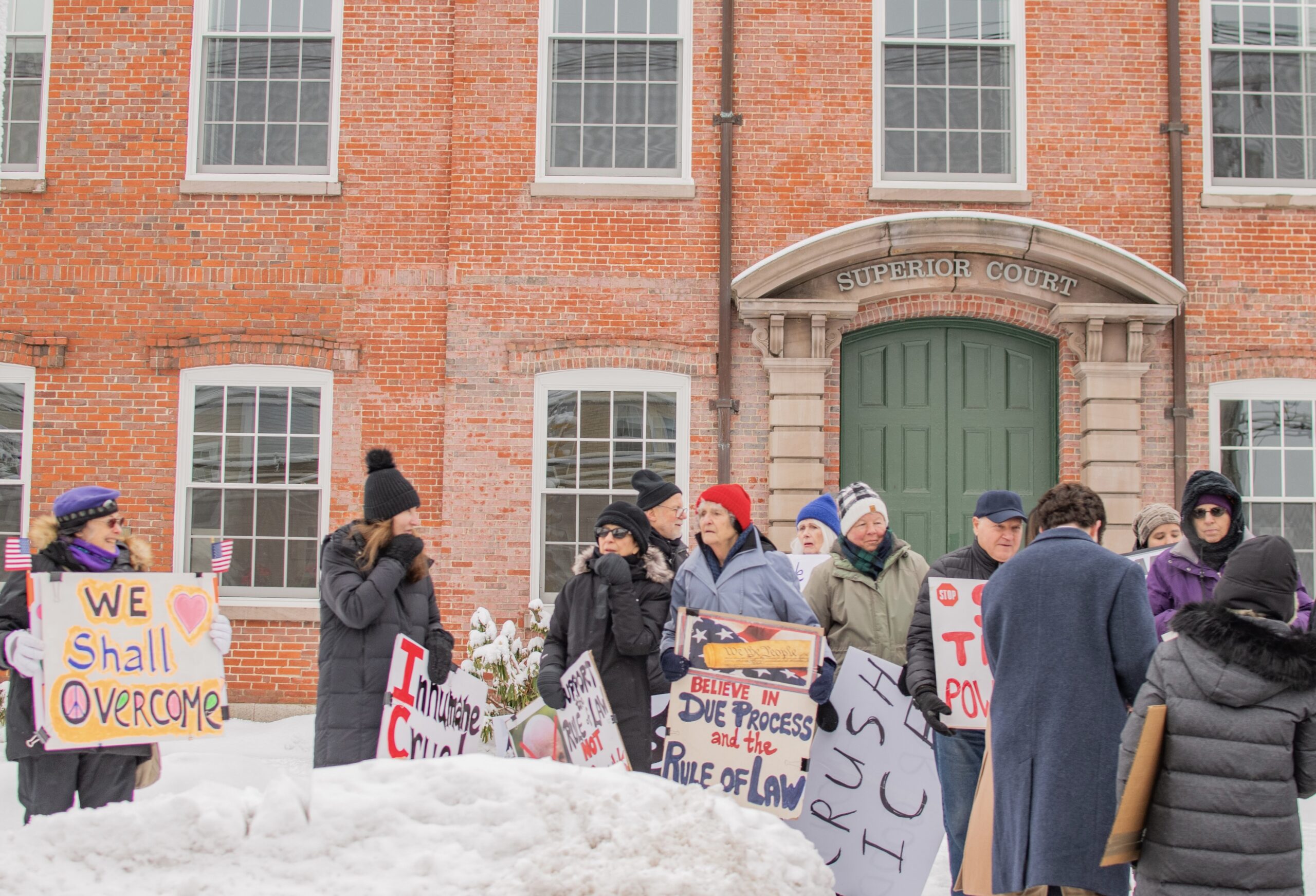
Local Protests Divide More Than Unify

The Townie is an opinion website. The views expressed in this piece belong solely to the author, do not represent those held by The Townie, and should not be interpreted as objective or reported fact.

I had a conversation once with a woman who used the fact that her daughter had been arrested for possession of mushrooms when she was 18 as a sort of bludgeon in arguments, bullying her daughter into a box of self-doubt and recrimination by telling her, “I’ve never been arrested in my life.” I remember saying, “have you even lived if you weren’t arrested in your late teens, early 20s, for a petty offense like vandalism, recreational drug use, or victimless act of destruction tied to a sociopolitical idea?” To this day, I wonder if it made her reevaluate her interactions with her daughter.

Some readers might disagree, but mixed emotions, irrationality, and ferocious, unsubstantiated passion are an entitlement of youth. Within safe parameters, those passions need to be allowed to rage. What they should not be allowed to do is influence global politics.

I guess that’s why it was so anguishing to have the scales ripped from my eyes over the last decade, to see that emotionalism and easy manipulability is not at all exclusive to the young. During Covid and the height of the BLM movement, I saw young adults (late high school, early college) at the vanguard of the protests, which often turned turbulent, even violent. I saw young adults armed by the media with the flame-gun of righteousness, burning to cinders anyone who dared contradict, or bring self-awareness to, their pure justice. None of that surprised me. What did surprise me was seeing them supported by the older generation.

But, why? How could people old enough to have lived through some of the greatest disasters and global shifts of the 20th and 21st centuries believe violence is justified, and align themselves with screaming children? The right to protest is the right of every American, and the obligation of every conscientious human being. However, I do not think these ICE protests are a good thing. Do not confuse what I’m saying with, “I think protests are a bad thing,” but I’m having trouble seeing these particular protests as anything but symptoms of a misguided ideology.

And before you say it, no, this isn’t because I’m pro- or anti-Trump. It’s about the concept of protests in general, and their merit when carried out performatively.

Protests are supposed to be the voice when a righteous cause has none, or is suppressed. This voice is designed to make as much noise as needed to reach the news stations, to force them to give this underrepresented problem coverage. The news conveys the issue to communities otherwise untouched by the issue. If the voice is powerful enough, these people can bring reform to the issue via communication with their politicians, financiers, and the elite with whom they intermingle. A protest should shake a tree so hard it shivers all the way to the top.

So imagine our confusion when the voice starts from the top, from the media itself. When the protestors are the very people a protest strives to reach. Where can a protest go when its primary aims were achieved before it ever began? 

Take to social media? Though the mainstream media is already shouting cardboard sign slogans from the rooftops, surely these unstructured platforms are woefully quiet.

Except, these mediums are, every single one of them, already saturated almost monomaniacally with “ICE out” and “No Kings.”

Well, ok. If the structured and unstructured medias are already overabundant with the information you’re trying very hard to give a voice to, and it’s you that the voice strives to reach anyways, what purpose does the protest serve? Who exactly is the person protesting, and what do they hope to accomplish? 

Having spoken with a dozen or more, and having driven down High Street every week, it is, almost invariably, a person in their late-50s to early-70s, wealthy, retired, culturally and ideologically homogenous. 

I remember walking around Newburyport during the Black Lives Matter movement — now faded to a few vestigial bumper stickers and a fuzzy, frustrating memory — back when every house in Newburyport had a BLM sign in their window. While walking around, it took a lot of self-restraint for me not to leave a note at these houses that said: “If you really care about this cause, sell your million-dollar home, give half to the cause, buy a cozy half-million dollar house in Amesbury or Haverhill and live no less comfortably.”

A friend asked me: So does that mean rich people aren’t allowed to hang a sign, or to protest? Of course not. But I think they should have a mirror held up to them. Pretty much everyone in this city enjoys a certain degree of prosperity.  Even the guy playing drums on overturned 5-gallon buckets lives in a literal mansion. These same people who taped the BLM signs to their fences have never protested a crisis in their lives beyond the crises that were delivered to their televisions, consolidated and packaged for easy, thoughtless consumption. Then, as though overnight, they faded out with Twilight Zone-esque choreography.

I believe that the wealthy, sheltered, big hearted (I mean that genuinely) folks of Newburyport bear a greater burden of responsibility to all the rest of the world. If you’re going to champion a cause which you perfervidly emphasize as a cause of dire need and immediate threat to all of democracy, do something about it. Buying a sign is not doing something. It’s laziness.

To be clear: Fuck Trump. Fuck Kamala. Fuck Bush. Fuck Biden. Fuck Hillary. This isn’t about party politics, this is about the reality that we are a global human community. I know I sound like a hippy. Like you were once, maybe.

All I’m saying is, don’t jump off the bridge your friends are leaping from without investigating their call to leap. You are the people that the poor, the young, the uninitiated look to for change. Waving signs on the side of the road is the most egregious disappointment of that responsibility. The government needs you to forget that the court of public opinion rules, and as long as you’re divided, the jury will always be out. Examine the source of your righteous anger and you’ll find it never came from your neighbor. It came from the light your newscaster framed him/her in. You’ll never achieve the change you want holding a sign on the side of the road.

All the protesting has achieved is to widen the gap between parties, and broadcast to the world that not only are we disunified as a national community, but we can’t resolve it in-house and we desperately want everyone to know it. I’m not saying Trump and ICE aren’t a problem. But I’m saying your mission is already accomplished, and the news channels are using you to sow instability, and stir the pot of inner community conflict. I’m also saying something along the lines of:  Trump is the monster YOU made.  

I hope you enjoyed this article, that it pissed you off, that it was thought provoking and fodder for real conversation. 

P. Neverette
Rowley resident

Passionate about a local issue? We want to hear from you. Check out our submission guidelines.

Subscribe to our Newsletter


Comments

7 responses to “Local Protests Divide More Than Unify”

  1. Stephen James Bresnahan Avatar
    Stephen James Bresnahan

    Great response and could not agree with you more. Thank you!

  2. Raymond Clements Avatar
    Raymond Clements

    Speaking Truth To Power.

    Your argument overlooks a central truth about American history: public protests have repeatedly been one of the most effective engines of democratic change. To dismiss today’s demonstrations as performative or misguided ignores the long lineage of movements that reshaped this country precisely because ordinary people refused to stay silent.

    The Civil Rights Movement is the clearest example. Sit‑ins, bus boycotts, and mass marches—almost entirely nonviolent—forced national attention on segregation and directly contributed to the Civil Rights Act of 1964 and the Voting Rights Act of 1965. The women’s suffrage movement used parades, pickets, and civil disobedience to win the 19th Amendment. The labor movement’s peaceful strikes and marches secured the eight‑hour workday, child‑labor laws, and workplace protections. None of these victories came from the “top,” and none would have happened if people had waited for media or politicians to act first.

    Your claim that modern protests “start from the top” misreads how public pressure works today. Media coverage doesn’t negate the need for protest—it amplifies it. Visibility is not the same as justice. The fact that an issue is widely discussed does not mean those in power are addressing it. Protest is often the only tool citizens have to convert awareness into accountability.

    Protesting publicly has never been about perfection. It’s about participation. It’s about refusing complacency. And it has changed America every time people were brave enough to show up

  3. Nancy Wright Avatar
    Nancy Wright

    I don’t disagree with some of your points however, protests are needed to unify groups that are standing up against a larger power and show other people that believe in the same, that they are not alone. And with numbers, comes strength. As you could see, when the protests are spread wide and far, across this country, it can and DOES make a difference. Social media and networks can discuss these topics, but the people still need to stand up and make their voices heard. That is essential. I spoke to many people at the protest in Newburyport when I attended. And I found comfort with the people there as it reminded me that people at a local level feel deeply about the causes they are representing. And yes, people should do whatever they can to help their cause and protesting is one and action that can be taken! People want to speak out about the terrible things that are happening in this country. And if you don’t agree with the protesters, no need to listen and move onto your own protest! I do not think that protestors or people of differing opinion created Trump. THAT is a whole other article. Thanks for bringing your opinion forward and I am glad that I can share my opinion, as well!

  4. Bil Silliker Avatar
    Bil Silliker

    Idunno… I’m no political expert here and I’m sure some of what you are saying rings true for some percentage of the people you refer to some percentage of the time. But I think maybe you over look those of us that aren’t owners of million dollar homes and those of us who despite our million dollar homes didn’t acquire them when they were considered million dollar homes. When I moved to Newburyport in the early 2000’s it wasn’t ridiculous to believe you could still get a home for under half a million. I have to believe many of those 50 to 70 year olds you refer to are owners of homes they bought for much less than a million and they’re still here because they’ve paid them off or can still afford their mortgages and like me.. they have community here.

    I’ve been a renter here since 2008, when our local business went out of business, partially due to the local politics of the day. We didn’t stay because we were wealthy, we’re far from that. We stayed because we had begun to build community and weren’t ready to leave. Then our daughter entered the local school system and all of her school friends were here and we gave up the idea of living somewhere cheaper for her to maintain those relationships. Now she’s in college in NY and we’re still here because we landed in a rental that I can still afford even though the rent has increased over the years. And our daughter still comes home to those friends on school breaks. And she keeps a local job so our being here continues to help her. And as sexagenarian parents of a young adult we think its more important for us to support her until she’s self sufficient than to up and leave for some other location that would lack the community we’ve formed over the past few decades (my wife has been here a decade longer than me).

    Are the reasons for a protest only those you defined? I honestly don’t know, and I suppose I could yahoo it (heh heh) but if that’s truly the only reason for protest then maybe we’re not protesting. Maybe we’re attesting. Attesting our commitment to stand up or speak up when our brothers and sisters across this country are being assaulted in some way.

    I’ve noticed that the attestations of our commitments can be weaker when the story isn’t fresh and sexy, and yes that is a bit disappointing, and I’m also guilty of the same. Does that make it any less important when those among us who carry the flame of resistance on their sleeves and not close to their chest organize a no kings day or a boycott of billionaire businesses? Should we all sit in our homes the next time a racist police officer shoots a defenseless black man, and say to ourselves “that’s too bad”? Or maybe you would suggest I move to a city or state where that is more prevalent and find an apartment for half the rent and donate the difference to a cause.

    The thing is we all live most days in the confines of our lives and worry about the bills we pay and our local issues that matter to us, but occasionally we are called upon by those who keep those other matters close to their daily concerns and call upon us to help them make some noise and if we feel the same way they do and we have the time, we show up. Will it make a difference? Maybe not. But sitting at home and silently shaking our heads certainly won’t fix anything. And being there on those days when we collect in numbers to make the noise gives us hope and in times like these we all need a little hope. I’ll take the hope even if the results are empty. I need hope. I need to see the numbers of people in my local community that are as disgusted as I am with the state of certain things that I can’t stomach.

    1. MaggieMay Avatar

      I love this response. Thank you for sharing this thoughtful perspective.

  5. Newburyport Citizen Avatar
    Newburyport Citizen

    The core flaw in this letter is that it confuses discomfort with illegitimacy: yes, some activism is performative, yes media ecosystems amplify outrage, and yes not every protest is strategically brilliant, but none of that invalidates protest as a democratic mechanism. Media saturation does not equal policy change, hashtags are not legislation, and visibility is not reform; protests today function less as information delivery and more as power signaling, voter pressure, and reputational risk for policymakers. Division is not created by protest but revealed by it, and history shows that nearly every major expansion of rights, from civil rights to antiwar movements to AIDS activism, looked loud, emotional, and disruptive at the time. Dismissing participants as wealthy virtue signalers ignores the legitimacy of solidarity and assumes that only the directly harmed may speak, which collapses collective action entirely. Suggesting people are merely manipulated by media strips them of agency while claiming intellectual independence.

    Protest is messy because humans are messy, but removing it from democracy because it is noisy leaves you with closed rooms, lobbyists, and quiet compliance; the real question is not whether protest feels uncomfortable, but whether visible friction is preferable to invisible power.

  6. Bailey Simpson Avatar
    Bailey Simpson

    Calling protesters who are showing up to try to protect their neighbors from extreme violence by ICE (who we know have been given free reign of their power) “performative” is so insulting. By not taking a side, you are taking one. If you educate yourself at all about non-violent protests, it is immediately clear that these people are some of the best organized protesters we’ve had in decades and they are responding to extremely concerning and inhumane government over reach!

    How do you know that these rich people you are talking about aren’t donating as well as participating in protesting? Even if they aren’t, vocal and visible support is important to raise awareness on these issues. That being understood, we need to remember that the media genuinely covers things that get a lot of attention. That is how things mobilize.

    I will agree with you on one thing, and that is there is such a wide gap between these two sides. However I don’t think that your points lead to a solution, and frankly this just seems like a privileged take on the situation. Sometimes the pot has to get stirred! You say at the end “I hope this pissed you off.” Don’t you see the irony in that?

Leave a Reply

Your email address will not be published. Required fields are marked *